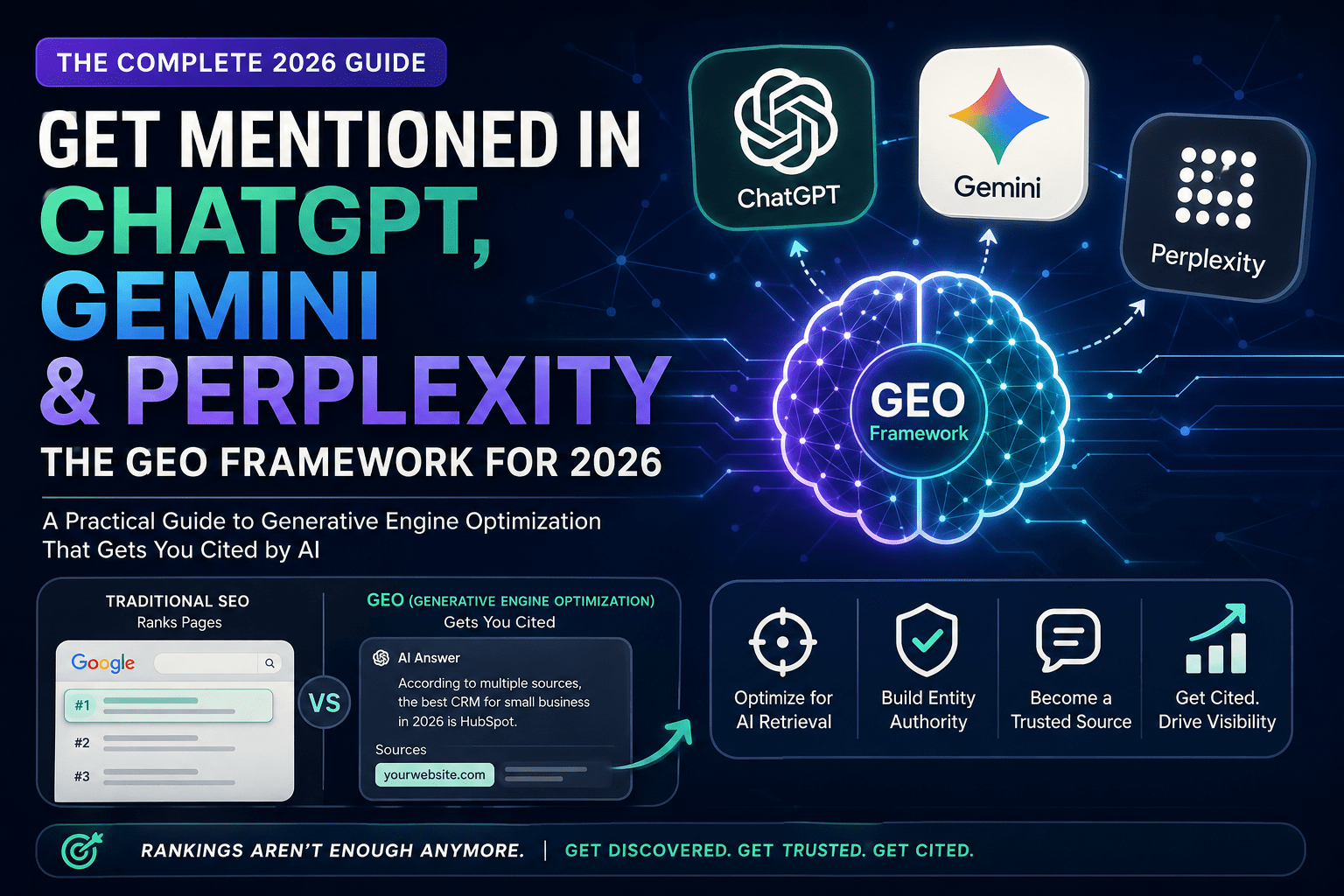
How to Get Mentioned in ChatGPT, Gemini, Perplexity & AI Overviews: The Complete GEO Framework for 2026
I spent the better part of last year staring at something that didn't make sense: a client ranking #1 for their money keyword on Google, watching a competitor ranked #6 get quoted by name in ChatGPT for the exact same query, over and over.That gap is the entire subject of this article.
Section 1: The Biggest Misconception About AI SEO
Most SEOs are still treating generative engines like a new SERP. They're optimizing title tags, chasing featured snippets, and hoping the same playbook that got them to position one on Google will get them cited in ChatGPT. It won't, and the reason is structural, not tactical.Google's ranking algorithm answers one question: which page best satisfies this query, given the click behaviour of millions of past searchers? It's a relevance-and-popularity contest, refined over two decades, and it's fundamentally comparative — page A vs page B vs page C.An LLM answering a question isn't running a comparative contest. It's doing something closer to evidence synthesis. It has already generated a draft answer from its training weights, and it's now deciding: do I trust this draft enough to state it plainly, or do I need to retrieve a source to back it up — and if I retrieve, which source do I lean on?That's a confidence decision, not a ranking decision. And confidence is built from a different set of signals than PageRank-style authority.Here's the part that trips up experienced SEOs specifically: a page can rank #1 because it's the best clickable answer to a broad query, while being a terrible citation candidate because it hedges, buries the actual number three paragraphs down, or reads like eight other top-10 pages that said the same thing in the same order. Google's ranking rewarded it for comprehensiveness and UX. The LLM doesn't care about UX. It cares about whether the specific sentence it needs is stated cleanly enough to lift.I saw this literally with a fintech client (a money-transfer product). They ranked top 3 for "send money to India from the UK" — solid position, strong domain. But when I ran the same query family through ChatGPT and Perplexity, they were absent. The site that kept showing up was a much smaller comparison blog, DR nowhere near ours, that had one thing we didn't: a table with exact transfer fees, updated dates, and a named author with a finance byline. The LLM wasn't rewarding their domain authority. It was rewarding the fact that their number was retrievable and attributable in one clean lift.That's the misconception in one sentence: ranking optimizes for "best page for a human to click." GEO optimizes for "safest sentence for a machine to repeat." Those overlap less than the industry assumes.
Section 2: Reverse Engineering How AI Systems Find Sources
Skip the academic definitions. Here's what's actually happening when someone asks ChatGPT or Perplexity a question, from the seat of someone who's been watching citation patterns across dozens of client verticals.The retrieval step (RAG) isn't a black box, it's a filter cascade. The system takes the query, expands it into related sub-queries (this is query expansion — "best CRM for small business" quietly becomes searches for "CRM pricing comparison," "CRM features small business," "CRM reviews 2026"), then runs retrieval against an index (its own crawled corpus, a live search API, or both, depending on the product). What comes back isn't one page — it's dozens of candidate passages. The generation model then picks which passages to actually cite.This is the step most SEOs never think about: you're not competing to be found, you're competing to be selected after you're found. Plenty of pages get retrieved into the candidate pool and never get cited because the passage that got pulled was vague, unattributed, or contradicted by three other candidate passages.Why does ChatGPT cite one website and ignore another that covers the same topic? In practice, from pattern-watching across client sites, it comes down to a handful of things:Passage isolability. Can a single paragraph or sentence stand alone and answer the question without needing the rest of the page for context? Pages that build an argument across six paragraphs before stating the conclusion get skipped in favour of pages that state the conclusion first and support it after.Entity clarity. Does the page clearly say who is speaking? A stat with no named source, no organization, no date reads as unverifiable. LLMs are conservative about repeating unattributed claims because hallucination risk cuts both ways — the model doesn't want to launder an unreliable number.Corroboration. If three sources say the same number and one says something different, the outlier gets dropped even if the outlier is your page. This is the single most underrated factor — being right and alone is worse, from a citation standpoint, than being repeated across a small cluster of trusted sources.Freshness signals that are actually verifiable. Not just a "last updated" stamp (those get gamed and the models increasingly discount them) but internal evidence of recency — a dated example, a specific version number, a stated "as of [month, year]."Entity recognition and knowledge graph relationships matter less at the sentence-retrieval level and more at the "should I trust this domain at all" level. If your brand entity is inconsistently represented — different name variants, no clear Wikipedia/Wikidata presence, no consistent author identity across content — the model has a harder time resolving "who is this" before it even gets to "what are they saying." Weak entity resolution doesn't block retrieval, but it lowers the confidence weighting on anything retrieved from you.
Section 3: The GEO Framework
I built this from the recurring pattern across every "why did they get cited and we didn't" audit I've run. It's not clever for the sake of being clever — it's five things that consistently mattered, in the order they need to be tackled.G — Ground every claim in a retrievable unit A retrievable unit is one sentence or table row that answers a specific question completely, without needing the surrounding page to make sense. Most content is written to be read top to bottom. GEO content needs to be written so any single paragraph could be lifted out and still be correct and attributed.Implementation: Rewrite your highest-value pages so the direct answer appears in the first 1-2 sentences of the relevant section, not the conclusion of a build-up. Use tables for anything comparative — LLMs lift table rows cleanly because they're already structured as isolated facts.Common mistake: Burying the actual answer under three paragraphs of "it depends" framing. Hedging language that reads as thoughtful to a human reads as low-confidence to a retrieval system deciding whether to cite you.E — Establish a consistent entity Your brand, your authors, and your organization need to resolve to the same "who" everywhere — your site, your social profiles, any directories, any press mentions. This is the unglamorous work of entity SEO: consistent naming, a real author bio linked across every article they write, structured data (Person, Organization, sameAs linking to verified profiles) that ties it together.Implementation: Audit every author byline for consistency. Add Person schema with sameAs pointing to LinkedIn, and Organization schema pointing to verified social profiles. If you don't have a Wikidata entry and you're a real business, that's worth the few hours it takes.Common mistake: Generic bylines like "Admin" or "Team," or worse, no byline at all. An unattributed claim is a claim the model has to independently verify or discount.O — Optimize for corroboration, not just originality Counterintuitive, but being the only source for a claim can hurt you. If nobody else corroborates your number, a cautious model will either not cite it or hedge it heavily ("one source suggests..."). The play is to get your original data referenced by a few other credible sources after you publish it — PR, digital PR link building, or straightforward outreach to niche publications — so the claim becomes cross-validated.Implementation: When you publish original research or a proprietary number, treat the outreach phase as part of the GEO strategy, not a separate link-building task. The goal isn't just backlinks for ranking equity — it's getting the same fact repeated in independent, trusted contexts.Common mistake: Treating original research as a one-and-done content asset instead of a multi-month PR push. The data point that sits alone on your site for six months without anyone else referencing it is invisible to corroboration-sensitive retrieval.R — Reduce retrieval friction technically This is the part that overlaps most with classical technical SEO, and it still matters. Crawlability, clean HTML structure (real <table> elements, not divs styled to look like tables), fast load times for crawlers that respect performance signals, and — increasingly relevant — whether your robots.txt blocks the specific AI crawlers (GPTBot, PerplexityBot, Google-Extended, ClaudeBot) that feed these systems.Implementation: Check robots.txt against the current list of AI crawler user-agents. I've seen clients accidentally blocking GPTBot via an overzealous bot-management plugin and wondering why they never show up in ChatGPT search results. Also: server-render your key content. If a page needs JavaScript execution to reveal its core text, some retrieval crawlers simply won't see it.Common mistake: Set-and-forget robots.txt rules written for 2019-era bot management, never revisited for the current crop of AI crawlers.O — Own a narrow topic completely, not a broad topic partially This is the DR-vs-depth argument in framework form (more in Section 7). Topical authority, for GEO purposes, isn't measured by how many pages you have on a subject — it's measured by whether you're the site that has answered every reasonable sub-question in a niche. Models build higher retrieval confidence in domains that show consistent, deep coverage of a narrow area over domains that have broad, shallow coverage of many areas.Implementation: Map every sub-question a user might ask about your core topic (use "People Also Ask," Reddit threads, and query expansion tools) and make sure each has a clean, isolable answer somewhere on your site. Interlink them tightly.Common mistake: Spreading content thin across adjacent topics to chase more keyword volume, which dilutes the topical signal that actually earns citations.
Section 4: Why Most Websites Will Never Be Mentioned by AI
Most sites fail for reasons that are unglamorous and completely fixable, but nobody fixes them because they don't show up in a traditional rankings report.Weak entities. A site with no clear "who" behind it — no author identity, generic "Written by the Editorial Team" bylines, inconsistent brand naming across platforms — gives the retrieval system nothing to anchor trust to. I've audited sites with genuinely good content undermined entirely by this; the content was accurate, but there was no resolvable entity making the claim, so it got treated as anonymous and skipped.Thin content dressed as comprehensive content. Pages that hit a word count target by repeating the same point in five different ways. LLMs are, if anything, better than humans at detecting that a 2,000-word page contains 300 words of actual information. Padding doesn't help you here the way it sometimes helped with older ranking signals.Lack of corroboration. Covered in Section 3 — a claim standing alone, no matter how well-written, reads as unverified.No author signals. Related to weak entities but specifically about expertise. A page about a medical or financial topic with no visible credential behind the author is a page the model has extra reason to be cautious about, especially post-2024 as these systems got more conservative on YMYL (your-money-your-life) topics specifically because of hallucination liability concerns.No unique data. If your page is a synthesis of what five other pages already said, in different words, there's no reason for the model to cite you specifically over the five pages it already has in its training data or retrieval index. Original surveys, proprietary datasets, first-party case studies with real numbers — these are what get pulled, because they're the only source for that specific fact.No citations from other trusted sources. This is the compounding one. If nobody links to you, mentions you, or repeats your data, you're both invisible to the corroboration signal in Section 3 and likely under-indexed by the crawlers feeding these systems in the first place. It's a two-layer problem: not just absent from AI answers, but often barely present in the underlying retrieval corpus.
Splitting this cleanly between what's been consistently observable across client work and public documentation, versus what's reasonable hypothesis based on pattern-watching.
Section 5: A GEO Audit Checklist
Does the direct answer to your target question appear within the first two sentences of its section?Is at least one comparative or numeric claim on the page presented as a table, not prose?Does the page contain at least one first-party data point (survey, case study number, internal benchmark) not found elsewhere?Is hedging language ("it depends," "in some cases") minimized around the core factual claims?Does every major claim have a clear, checkable source or is it presented as the author's own tested finding?Is the content depth on this narrow topic genuinely more complete than the top 3 ranking competitors, not just longer?Technical SEO (5) 7. Does robots.txt explicitly allow GPTBot, PerplexityBot, Google-Extended, and ClaudeBot? 8. Does the core content render without requiring JavaScript execution (check via "view source" or a JS-disabled crawl)? 9. Are tables built with real <table> HTML, not div/CSS approximations? 10. Is page load time reasonable for crawler timeout windows (test with a basic crawler, not just PageSpeed)? 11. Is there a clean, crawlable sitemap that includes your highest-value GEO target pages?Brand Signals (5) 12. Is your brand name used consistently (no variant spellings) across your site, socials, and directories? 13. Do you have unlinked brand mentions building up on other sites, not just backlinks? 14. Is there third-party coverage or corroboration of your key data points/claims? 15. Do you have a presence on platforms LLMs are known to draw from (Reddit, Wikipedia/Wikidata, G2/Capterra for B2B, industry directories)? 16. Is your organization represented consistently across LinkedIn, your site footer, and any press mentions?Entity Optimization (5) 17. Does every article have a named author with a real bio? 18. Is Person schema applied with sameAs links to verified profiles? 19. Is Organization schema applied site-wide with consistent NAP (name/address/if relevant)? 20. Do author bios state specific, checkable credentials relevant to the topic? 21. Is there a single canonical "about" or entity hub page that ties author + org + brand together?AI Retrieval Readiness (4) 22. Have you tested your target queries directly in ChatGPT, Perplexity, and Gemini to see who currently gets cited? 23. When you're not cited, have you identified what the citing source has that you don't (data, structure, corroboration, entity)? 24. Is your most important data updated with a checkable, specific "as of" reference rather than a generic last-modified date? 25. Do you have a process for re-testing these queries quarterly, since citation patterns shift as models are updated?
Section 6: Case Study Simulation
Website A — DR 20, a specialized niche site covering one narrow topic (say, commercial kitchen ventilation compliance) with original inspection data, a named author who is a licensed contractor, and tightly interlinked sub-topic pages.Website B — DR 70, a broad home-improvement publisher with a page on the same topic, written by an editorial team, covering it as one of thousands of similar generalist articles, well-optimized for classic on-page SEO, backed by strong domain-wide backlink profile.For the query "what CFM do I need for a commercial kitchen hood," here's how the citation decision likely plays out. Website B's domain authority gives it a strong chance of ranking well in traditional Google results — DR 70 with solid on-page optimization typically wins the comparative ranking contest against a DR 20 competitor on a moderately competitive query.But the LLM isn't running that contest. It's asking: which passage most confidently and specifically answers this exact question? Website A's page states a specific CFM range tied to hood type and cooking equipment, sourced from the author's own inspection work, structured as a table by equipment category. Website B's page covers the topic more generally, folded into a broader "commercial kitchen equipment guide," with a vaguer range and no attribution beyond "industry standards."Website A wins the citation, not despite its lower DR, but because domain authority was never the variable that mattered for this decision. The variables that mattered were passage isolability, entity credibility (a named licensed contractor vs. an editorial team), and specificity of the data. Website B likely still gets more raw traffic and probably outranks Website A in classic search — the two outcomes aren't in conflict, they're answering different contests. That's the core lesson: DR and citation likelihood are correlated but not causally linked, and the correlation breaks down fast at the level of a specific, narrow, technical query — exactly the kind of query where LLM citation decisions actually get made
Section 7: The Future of Search (2027 Prediction)
A few grounded, non-sensational predictions based on where the trend lines are actually pointing, not where headlines want them to point.AI Overviews will keep expanding query coverage, but citation slots will stay scarce. Google's AI Overviews already cover a large share of queries; the trend is toward broader coverage, not fewer overviews. But the number of citation slots per overview isn't growing proportionally — meaning competition for the handful of visible citation spots per query will intensify, not ease.ChatGPT Search and Perplexity will keep converging toward the same underlying citation logic, even as their UIs differ, because they're solving the same trust problem: how do you cite without hallucinating and without legal exposure. Expect citation behaviour across these tools to become more similar to each other over time, not more distinct."Search Everywhere Optimization" becomes the practical framing, not a replacement for SEO but an extension of it. The skill set that wins here — entity clarity, structured data, corroboration-building, passage-level clarity — is the same skill set that wins in classic SEO, just with different weighting. Practitioners who frame this as "abandon SEO, learn GEO" are wrong; the correct framing is "the weighting of factors you already half-know shifted, and a few new technical factors (crawler access, passage isolability) got added."Entity-first SEO stops being optional for anyone competing on informational queries. Sites that never invested in clear author identity, structured data, or brand consistency will find the gap between their classic rankings and their AI visibility widening, because that gap is already visible today and the mechanism driving it (entity resolution as a trust gate) isn't going away.Gemini's advantage will remain Google's own knowledge graph and index integration, which means sites already well-optimized for classic Google entity understanding (Knowledge Panels, structured data, Search Console-verified entities) will have a natural head start there that doesn't automatically transfer to OpenAI or Perplexity's separate retrieval systems — meaning cross-platform GEO work can't be a single checklist applied once; it needs platform-aware testing.None of this requires abandoning what already works. It requires treating "get cited by an LLM" as a distinct, testable outcome from "rank well," measuring both, and building content that can satisfy both without pretending they're the same problem.
Conclusion
The sites that will win AI visibility over the next few years aren't necessarily the sites that win classic rankings today — though there's real overlap. The winners will be the ones that treat "get cited by a machine deciding whether to trust me" as a distinct, measurable goal, and build toward it deliberately: clear entities, isolable answers, corroborated data, and content that specializes instead of sprawling. That's a smaller list of changes than most GEO content implies, and it's more testable than most people assume — you can check your own citation status today, for free, by just asking the tools the same questions your customers would.